
Bought, not owned
The Car Is the Sale. The Subscription Is the Business.
The car business has always been a grind. You buy glass and aluminum and rubber and plastic and labor and factories and warranties and dealer margin, you build one very complicated machine, you certify it for every market where it sells, you sell it once, and in a good year you keep somewhere around a dime of every dollar. General Motors would rather be in a different business, and it has been unusually blunt about why.
About seventy cents on the dollar.
That is the gross margin GM’s chief financial officer, Paul Jacobson, has put on OnStar and Super Cruise, the connected-software services bundled into its cars. He has called it a massive difference from the core, traditional business, and the numbers are no longer small. GM’s deferred software and services revenue reached $6.3 billion in the second quarter of 2026, an increase of nearly fifty percent from the same period a year earlier. OnStar crossed twelve million subscribers in 2025 and keeps climbing.
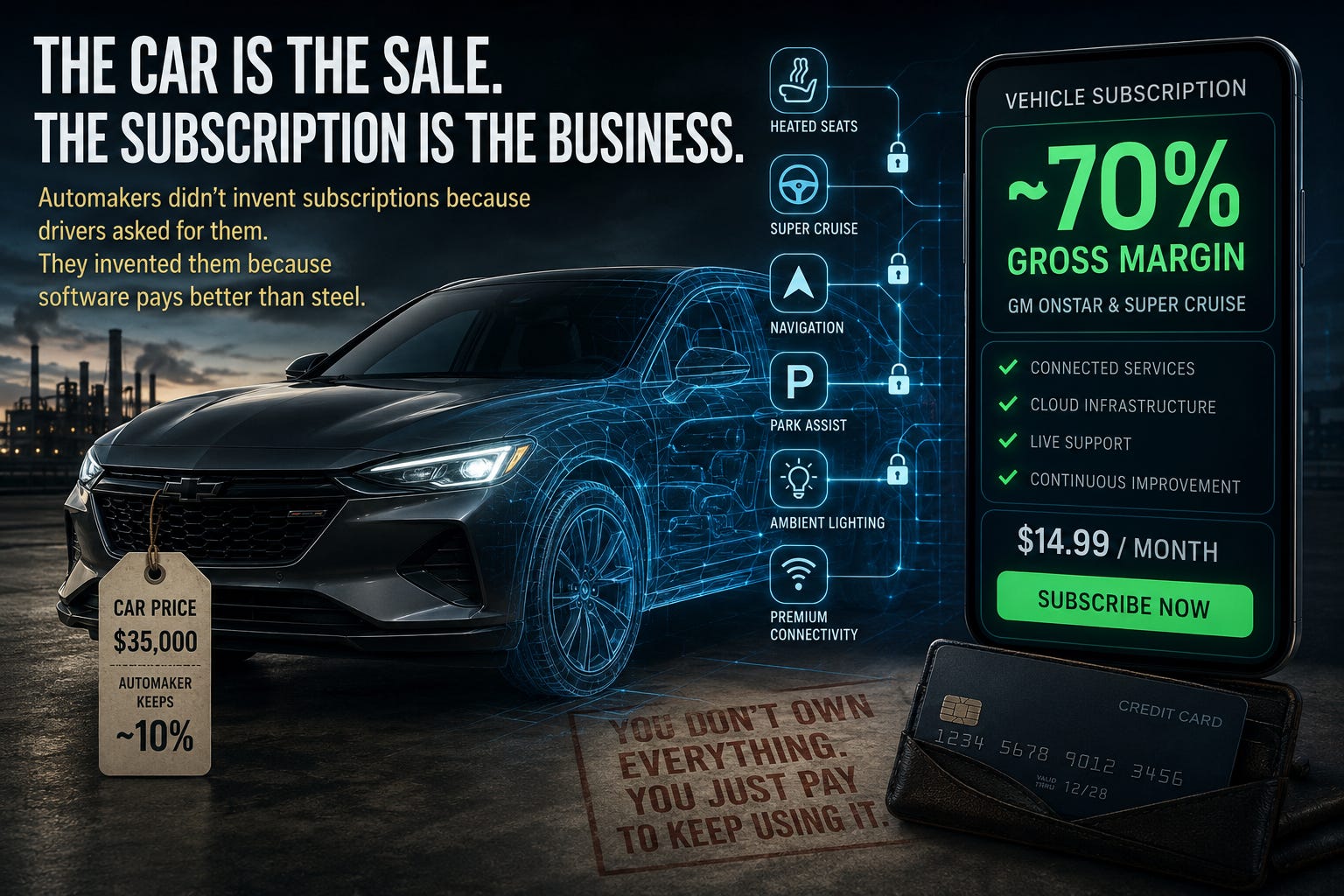
Here is the part worth keeping honest, because the excited version gets it wrong. GM is not abandoning the car. That same quarter it booked $48 billion in revenue, almost all of it from building and selling vehicles, while OnStar is on pace for a little over three billion dollars in realized revenue for the full year. Software is roughly two percent of the top line. What it is not is two percent of the ambition. It is where the margin lives, and margin is where a company decides what it wants to become. GM has decided.
Set that seventy percent next to the eight-to-ten percent EBIT-adjusted margin, the operating margin, that GM targets in its North American vehicle business. Build an enormously complex automobile and hope to keep a dime. Or rent access to code already sitting inside that automobile and keep seventy cents. GM moved back into that target range in the second quarter of 2026, which only sharpens the point: even a strong quarter in the metal business earns a fraction of what the software earns. That is the answer to why every manufacturer suddenly wants your credit card on file. It has little to do with the ownership experience. It is a low-margin manufacturing business trying to become a high-margin recurring-revenue business, in public, in real time.
One honest caveat the industry will not offer. Seventy percent is gross margin, not money in the bank. GM still pays for engineering, cybersecurity, servers, support and overhead. But gross margin is where a company chooses its future, and GM has chosen.
Building the car is the hard part
Earning money from a vehicle is genuinely difficult. You design it, prototype it, test it, certify it, source thousands of parts from around the world, build the plants, train the workers, assemble it, ship it, market it, warranty it and stock replacement parts for a decade. One bad component becomes a costly recall across hundreds of thousands of cars. Once the sale closes the manufacturer is mostly finished making money from that owner, apart from wear parts and periodic maintenance. The dealer might earn something on service and accessories. The factory has cashed its check.

Software rewrites the arithmetic. A feature is built once and sold to everyone, say the heated pads already installed in the front seats. The hardware is bolted into the fleet, so activation can be little more than a digital flag flipped in your account. One line of code moves from zero to one. Nobody installs a new module on your car to warm your seats next month. They just keep billing the card.
This is why the whole industry is moving in the same direction. Ford has built a real business here. Its Pro software subscriptions are approaching 900,000, at gross margins Jim Farley pegs near fifty percent, and Farley keeps telling investors to stop looking at Tesla’s self-driving and look at Ford Pro instead. Tesla sells Premium Connectivity and supervised Full Self-Driving. Mercedes sells downloadable extras. Hyundai and Kia run digital stores that sell features after the car is already in the driveway, instrument-cluster themes among them, for a monthly fee. Even the cautionary tale points the same way. BMW floated heated-seat subscriptions in 2022, got publicly roasted, and backed off. The retreat was tactical, not philosophical. The rest of the industry simply learned to package it better.
A service and a ransom are not the same thing
Not every automotive subscription is a scam, and pretending otherwise weakens the case. OnStar runs on cellular networks, call centers, cloud infrastructure and live emergency response with AI and human agents. Traffic data has to be collected and refreshed. Streaming needs bandwidth. A driver-assistance system that keeps improving needs continuous engineering and regulatory work. Those things cost money every day, and charging for them is fair.
The problem starts somewhere else. It starts when a manufacturer bills you, month after month, to use hardware that was already bolted into the car and already priced into what you paid. Heated seats and cluster graphics do not need a cell tower. Extra ambient lighting does not need a call center. A parking system may already carry every camera, sensor, motor and processor it needs, sitting idle only because you bought the lower trim, even though the hardware left the factory installed. At that point you are not buying a service. You are paying the manufacturer not to switch off part of the car you already own.
Picture buying a house where the builder bolted a working solar charger to the roof, then billed you ten dollars a month to use it. (Let us not give them ideas!)
The industry calls this “features on demand,” which sounds nicer than “equipment behind a paywall.” The question underneath is simple. If I bought the whole vehicle, and the hardware is physically in the vehicle, what exactly did I buy? The privilege to pay a monthly fee?
The used-car market is where this turns ugly. Under the old rules, whatever was attached to the car came with the car. Leather stayed leather. A stronger engine did not lose horsepower at the title transfer. Cruise control did not switch itself off because the last owner stopped paying. Under the software-defined model, a used car can arrive full of hardware the new owner is locked out of, because the feature was tied to the first buyer, or the first subscription, or a manufacturer-controlled account. The same installed equipment can be sold again to the next person, and the one after that. The machine stays in the driveway. The control stays with the manufacturer.
Two countries, one dodge
The United States has laws against deceptive billing but no clear national rule about hardware you have paid for and cannot use. The Federal Trade Commission (FTC) can pursue unfair or deceptive charges under Section 5 of the FTC Act, and the Restore Online Shoppers’ Confidence Act (ROSCA) requires clear disclosure and consent for online recurring charges. The FTC’s broader click-to-cancel rule, which would have made canceling as easy as signing up, was vacated by the Eighth Circuit on July 8, 2025, on procedural grounds, because the agency skipped a required cost analysis. The FTC restarted the process in early 2026 with a new advance notice of proposed rulemaking. In the meantime American protection is a patchwork: some states have strong automatic-renewal laws, some barely bother, and your rights can turn on where you live and which state’s law the contract claims.
Every one of those rules polices the process. Was the price disclosed? Did you consent? Could you cancel? Fair questions, none of which touches the one that matters. Nothing in the federal framework says hardware installed in a car you bought must stay usable without ongoing payment. You think you are buying a fully specced car from a friend, only to learn your friend owns a base model and pays monthly for the premium features. Disclose the paywall clearly enough and the buyer is still trapped inside a lawful, fully disclosed bad deal.
I live in South Korea, and my ear stays tuned to how the market and the government here behave differently. Seoul handles the process better, and it is worth seeing how. Since February 14, 2025, the amended E-Commerce Act bans six dark patterns, and the hidden-renewal rule has teeth: a business must obtain your separate consent at least thirty days before it raises a recurring charge or converts a free service to a paid one. Silence is not agreement. A vague email and a higher price is not agreement. Korea’s Fair Trade Commission can also strike unfair standard contract terms, including clauses that let a company change fees without consent. A Korean buyer stands on a steadier floor than an American one, who may first have to work out whether ROSCA applies, whether a state law covers it, and whether the contract quietly forced arbitration.
Here is the part the comparison usually skips. Korea protects the transaction. It does not protect ownership either. Hyundai and Kia sell feature upgrades through in-car stores after the sale. Where the hardware for a locked feature already shipped installed, a Korean driver can be safe from a surprise price hike and still be asked to pay monthly to switch on equipment already sitting in the car. Better guardrails around the model, not a rejection of it. Neither country has answered the real question, and one of them is only more polite about not answering it.
What a real rule would look like
The fix is not to ban paid connected services. A service that costs money to run can reasonably cost money to keep. The line worth drawing separates two things the industry blurs on purpose. On one side, genuine ongoing services with genuine ongoing costs: cellular data, emergency response, live traffic, cloud storage, streaming, a driver-assist system under active development. Charge away. On the other side, functions that run on hardware you already bought and that need nothing further from the manufacturer once the car leaves the factory beyond warranty and recalls: heated seats, fixed lighting, an artificial rev limit, fog lights, a basic parking feature, extra power outlets. Those should travel with the car and stay operational for its service life. A one-time paid upgrade, fine. A monthly fee for hardware you own is not a service. It is a charge for permission to use what you already paid for.
At a minimum, before you sign, a manufacturer should have to tell you which installed parts are software-locked, which features require continuing payment, whether any of it transfers to the next owner, whether you can buy permanent activation, whether the price can move after you drive off, and what happens when the company ends the service or the cellular network shuts down. Without that, the window sticker shows the purchase price and hides the real one: the cost of keeping your own car fully working across ten or fifteen years.

Used-car buyers deserve the same warning. The heated seats might be running on the dealer lot and go dark the moment you sign, unless you start paying. That can happen to a buyer who was never told. Disclosure rules should force used-car dealers to name the paywalled features before the sale, not after.
Automakers have always wanted loyalty. A loyal customer buys another car in five years. The subscription model offers something better than loyalty. It offers dependency, and dependency bills monthly. That is what the seventy percent number measures. Under the old deal, the maker sold you the machine and let go. Under the new one, it sells you the machine and keeps a hand on the switch, deciding which parts stay on, which follow you to the next owner, and which cost extra to wake up. Fair enough, when the switch controls a real service. When it controls hardware you already bought, the monthly fee stops being a service charge and becomes rent on your own property.
So the car sits in the driveway. The sensors are in the bumper, the computer behind the dash, the heating element under the seat, all of it bought and paid for and sitting right there. You can see it. You just cannot turn it on.
If you liked this article consider subscribing to my blog to see more like it. Subscriptions are free. And if you see any value on my writing consider buying me a coffee at: Buy Me A Coffee
References
Sanchez, Rex. “GM Thinks Subscriptions Could Make More Money Than Selling Cars.” Autoblog, March 31, 2026. https://www.autoblog.com/news/gm-thinks-subscriptions-could-make-more-money-than-selling-cars
“GM OnStar Business Revenue Increases 20 Percent In Q2 2026.” GM Authority, July 2026. https://gmauthority.com/blog/2026/07/gm-onstar-business-revenue-increases-20-percent-in-q2-2026/
General Motors. “Q1 2026 Letter to Shareholders.” GM Investor Relations, April 28, 2026. https://investor.gm.com/news-releases/news-release-details/q1-2026-letter-shareholders
“GM reports revenue of $48B in Q2, updates full-year guidance.” WardsAuto, July 2026. https://www.wardsauto.com/news/gm-reports-revenue-of-48b-in-q2-updates-full-year-guidance/825852/
Wayland, Michael. “Ford launches new AI to grow multibillion-dollar Pro commercial business.” CNBC, March 10, 2026. https://www.cnbc.com/2026/03/10/ford-pro-ai.html
“Ford Pro Paid Software Subscriptions Surpass 800K Mark.” Ford Authority, October 24, 2025. https://fordauthority.com/2025/10/ford-pro-paid-software-subscriptions-surpass-800k-mark/
“FTC’s Click-to-Cancel Rule Vacated Ahead of Planned July 14 Effective Date.” Morgan Lewis, July 11, 2025. https://www.morganlewis.com/pubs/2025/07/ftcs-click-to-cancel-rule-vacated-ahead-of-planned-july-14-effective-date
“Negative Option Rule.” Federal Trade Commission, March 11, 2026. https://www.ftc.gov/legal-library/browse/rules/negative-option-rule
“Regulations on Dark Patterns Take Effect and KFTC Publishes a Q&A on Enforcement of the Regulations.” Kim & Chang, 2025. https://www.kimchang.com/en/insights/detail.kc?sch_section=4&idx=31410
“Dark Pattern Regulation: Global Trends and Financial Sector Needs.” Korea Capital Market Institute, July 8, 2025. https://www.kcmi.re.kr/en/publications/pub_detail_view?syear=2025&zcd=002001017&zno=1857&cno=6572