Momentum as Debt
A Night Ride on a Slow Motorcycle in Korea

Night comes quietly in Korea, not like a switch being flipped, more like the city remembering how to breathe again.
By day these streets are a grindstone. Buses shouldering lanes, delivery trucks bullying slower cars out of the way, scooters flicking between cars like sparks off a blade. People everywhere, moving with purpose or pretending to. Noise stacked on noise. Korea is always in a hurry when it is awake. You must ride defensively, mechanically, eyes always ten seconds ahead, hands light but ready to swerve. The bike is there, but it’s just transportation, muted, caged by traffic and timing.
Then night rolls in and the city empties out.
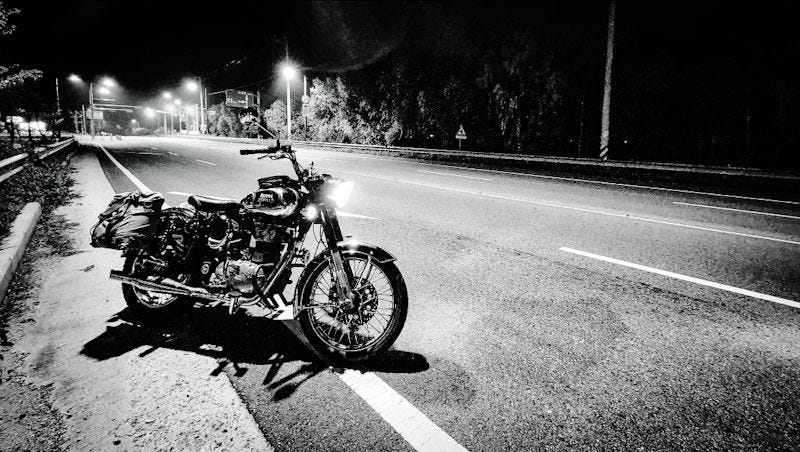
I wheel the Royal Enfield into the cool air and thumb the starter. The single cylinder fires up immediately, settling into that familiar rhythm. Thump thump thump thump.
Not fast. Not eager. Just steady. A big piston doing honest work.
No rush. No destination that matters.
The first few blocks are taken gently. Let the oil warm. Let the gearbox wake up. Let myself settle into the cadence of forward movement. The big headlight cuts a narrow tunnel through the dark, bouncing off shop windows and metal shutters. Korean signs glow faintly in blues and reds, advertising places that won’t open for hours. By day these streets feel narrow and impatient. At night they open up. The lanes belong to me.
The Enfield isn’t powerful. Anyone who thinks riding is about horsepower would miss the point entirely. What it has is momentum, class, and feel. The long-stroke motor pulses through the bars and into my hands, into my chest. Every combustion feels like a heartbeat. It doesn’t scream. It talks like an old friend along for the ride.
I roll on the throttle and let the bike lope along at fifty, sixty kilometers an hour. The exhaust note settles into a low, hollow thud that echoes off concrete walls and underpasses. Thump thump thump thump.
In daylight that sound disappears instantly. Now it travels. Now it matters.
Intersections slide by without stopping. Green lights waiting for traffic that never comes. I glance left and right out of habit, but there’s nothing there. No taxis hunting fares. No delivery vans parked half in the road. Just empty crosswalks and the faint smell of damp pavement.
On the city’s edge, a lone rural light stands guard over an intersection of shadows. It hangs red and patient, signaling alone. I slow, but the road is a black void in both directions. No headlights, no ghosts, no reason to wait. I roll on the throttle, passing through a wash of crimson that bleeds across the pavement and flashes off the chrome tank. For a heartbeat, the world is a warning light to no one but me, so I don’t stop. On a slow bike, momentum is a debt you don’t pay unless you have to. The Enfield carries the rhythm forward, pulsing steady as I leave the red glow behind.
Beyond that, the road stretches and relaxes. An onyx ribbon winding aimlessly, framed by thin white stripes beckoning me forward.
Finding its stride on the longer sections, the Classic 500 settles. Fourth gear now, then fifth, the motor’s heavy pulse smoothing into a rhythmic hum. Basic and old-fashioned, the suspension offers an honest dialogue with the asphalt: no filters, no lies. Through the pegs and bars, the road reveals itself: a muted knock from an expansion joint here, the sudden slickness of a painted line there. If you’re willing to listen, the bike never stops talking. Thump thump thump thump.
Through neighborhoods that are chaos by day, we roll in peace, man and machine in harmony. Markets shuttered; plastic chairs stacked. Like a lighthouse in the gray-black, a lone convenience store glows awash with colors, illuminating a tired clerk lost in a phone. Unimpressed, a cat watches me as I glide by.
There’s a strange intimacy to riding through a sleeping city. You see it without makeup. Just the contrast of shadows hiding mystery, with bright lights highlighting dangers. No crowds to distract you, no urgency to hurry you along. Just concrete, polished steel, and empty sidewalks. Korea at rest feels almost fragile, like you could break it if you revved too hard.
So I don’t.
I keep the revs low. Let the engine breathe. Thump thump thump thump.
I let the bike carry me instead of pushing it. The Classic likes this pace. It was built for roads that go on forever, not for stoplight sprints. It rewards patience. This bike doesn’t race the clock; it simply ignores it.
Under an overpass the sound deepens, the exhaust note bouncing back at me, amplified and rounded. For a moment it feels like flying low over water, skimming along inside your own noise. Then I’m out the other side and it’s quiet again, just the honest boom of the exhaust behind me.
This is the part that’s hard to explain to people who don’t ride. Or who only ride fast. Or who only ride to get somewhere.
At night, alone, on a simple motorcycle, the world reduces itself to essentials. Speed becomes irrelevant. Time stretches. Problems lose their sharp edges. You’re not escaping anything, exactly. You’re just putting it all in proper scale. Forward movement is all that matters.
Eventually I realize I’m farther out than I thought. No gas gauge to consult, no warning light to negotiate with. Just a rough sense of distance and consumption, the math you do without thinking. About fifty kilometers from home, far enough that it registers. Close enough that it doesn’t worry me. I turn back, choosing familiar roads, letting the ride fold in on itself.
The bike feels warm now, settled, like it could go on all night if I asked it to, but discretion matters on a machine like this. You don’t press your luck. You work with it.
Within sight of home I shut the engine down. The headlight stays on as the motor goes silent, and I coast the last fifty meters on momentum alone, clutch lever pulled in tight. Tires hum over concrete. No throttle, no combustion, just rolling mass and balance. Keeping the momentum going, the debt I mustn’t pay. The bike glides under the carport and eases to a stop as if it planned it that way.
I put it on the side stand and step off.
The engine is already pinging, entropy taking its toll. Soft metallic clicks and pops as heat bleeds out of cast metal fins, the sound of a machine settling after honest work. I start the small ceremony that always follows a cool ride. Gloves come off first, fingers stiff and warm, then the helmet, lifted clear and set aside. I unzip the jacket slowly, feeling the night air seeping in again. Nothing rushed. Nothing skipped. Each motion marks the end of something that mattered.
The bike ticks quietly beside me, cooling, present but finished. It feels like punctuation rather than noise. A sentence ending exactly where it should.
Tomorrow the streets will fill again. The noise will come back. The bike will become transportation once more.
But for a few hours, under a Korean night sky, on an old single-cylinder machine, the roads were mine, and the bike was my partner.
And that was enough.